
Why did the documentary screening focusing on Umar Khalid generate significant debate at NLSIU Bengaluru?
The scheduled screening of a documentary focused on former Jawaharlal Nehru University student activist Umar Khalid at the National Law School of India University in Bengaluru quickly became a subject of national media coverage and campus debate. Public interest in Umar Khalid stems from his long-standing involvement in high-profile legal proceedings and public student movements. When a student group at the premier law school announced the event, it attracted contrasting reactions from different campus entities and external student bodies. Proponents of academic freedom and open political discourse view campus screenings as an integral part of higher education and legal analysis. Conversely, political student organizations expressed strong opposition to holding an event centered on a figure involved in ongoing legal controversies. The intersection of public law institutions, student activism, and media scrutiny turned the planned screening into a broader national conversation regarding what subject matter is suitable for student-organized academic forums.
What actions did the ABVP take in response to the planned screening on campus?
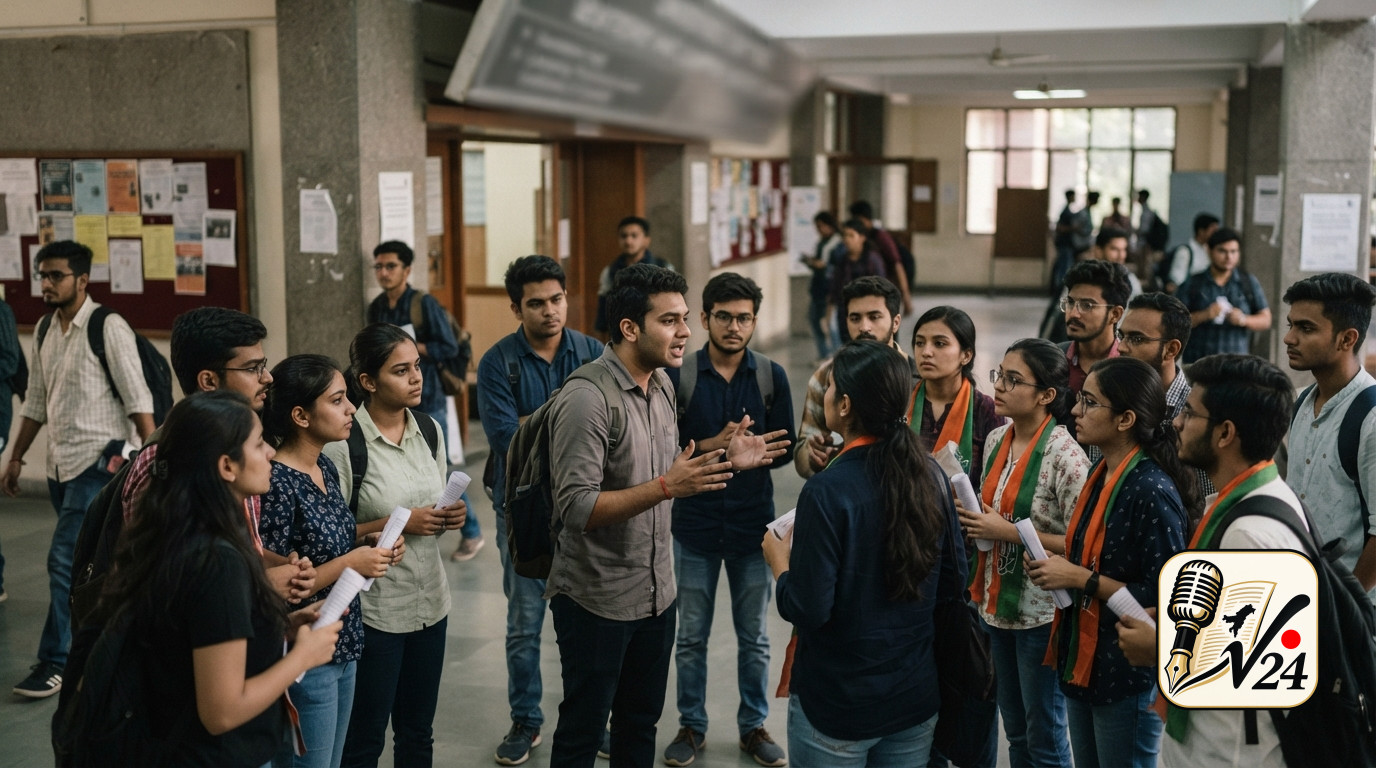
The Akhil Bharatiya Vidyarthi Parishad, a national student organization, organized active protests opposing the documentary screening at the Bengaluru campus. ABVP members voiced strong objections to the event, raising concerns about the subject of the film and questioning the appropriateness of conducting such a public screening within a prestigious legal institute. The demonstration brought heightened visibility to the venue and created political tension around the university campus. Protesters demanded that the event be halted or cancelled, arguing that public screenings about controversial political figures should not be hosted on university premises. The public mobilization by ABVP members became the primary external catalyst that drew media outlets like NDTV, The Times of India, and Live Law to report on the unfolding dispute in Bengaluru.
How did the NLSIU student group justify postponing the documentary event while denying external pressure?
Following the opposition and public row surrounding the event, the NLSIU student group responsible for organizing the film screening officially decided to postpone the program. However, in a public communication regarding the delay, the student organizers explicitly stated that their decision was not made out of submission to external demands or intimidation. The group denied bowing to any political or external pressure, framing the postponement as a calculated administrative choice to ensure orderly proceedings rather than a surrender of their right to hold academic discussions. By issuing this statement, the organizers attempted to preserve their institutional autonomy and uphold their stance on academic discussion while managing immediate operational and administrative challenges on campus.
Who are the primary key groups involved in the campus row surrounding the Umar Khalid documentary?
The controversy prominently involves several key entities representing legal education, student activism, and public reporting. At the core of the event is the NLSIU student group that selected the documentary for campus presentation and managed the logistics of the gathering. Opposing the screening is the ABVP, whose members organized demonstrations to halt the presentation. The subject of the documentary itself, Umar Khalid, is a former JNU student activist whose legal cases have been widely covered across Indian national media. Additionally, the university administration of the National Law School of India University in Bengaluru forms the background institutional setting. National media organizations, including Live Law, NDTV, and The Times of India, reported the events, capturing the perspectives of both the organizing students and the protesting student union.
Where did these campus developments unfold and why does the venue matter in legal education?
The events took place at the National Law School of India University campus located in Bengaluru, Karnataka. NLSIU is widely recognized as one of India's premier legal education institutions, training future jurists, advocates, and policy makers. Because of the institution's prominent reputation in legal scholarship and rights-based education, developments occurring within its campus command significant national attention. Controversies involving free speech, screening of political documentaries, and student union protests at NLSIU often serve as focal points for public debates regarding constitutional liberties, assembly rights, and the role of academic spaces in contemporary India.
When did the controversy peak and what official timeline details have been released?
The opposition and public row surrounding the film screening materialized rapidly around the scheduled date of the event in Bengaluru. Demonstrations led by the ABVP were staged on the day of the planned program, leading to media coverage standardizing the sequence of events. In response to the growing public attention and campus opposition, the organizing student group announced the official postponement on the same day. While news reports confirmed the disruption and subsequent postponement, official sources have not yet publicly specified a definitive rescheduled date for the screening.
What evidence and official accounts exist regarding campus security and public interest surrounding the event?
Reporting from Live Law, NDTV, and The Times of India confirms the primary factual elements of the event: a documentary screening on Umar Khalid was scheduled by an NLSIU student body, protests were conducted by ABVP members, and the organizers subsequently postponed the session while publicly asserting that they did not yield to external pressure. Available reports do not explicitly detail whether campus security forces or municipal police intervention was formally requested, nor do available sources publish the full internal regulatory decisions of the university administration. The public record primarily consists of statements from the student group, direct reporting on the ABVP protest activities, and video footage covering the row outside the university premises.
What lies ahead for future film screenings and academic discussions at the university?
The postponement leaves the future timeline for the documentary screening unannounced, as organizers have yet to clarify when or under what modified conditions the session might be held. Moving forward, the incident highlights ongoing tensions surrounding controversial student-led discussions on university campuses across India. The resolution of this row may influence how student bodies arrange future cultural and academic events, how university administrative policies handle political topics, and how campus authorities balance rights of expression with safety and operational order.
Sources
More from National