
What recent developments led to the renewed focus on India's fifth-generation stealth fighter jet plans and Russia's Su-57 offer?
The strategy surrounding India's future fighter fleet has come under heightened focus following a series of high-level reviews and public statements regarding stealth jet acquisitions and indigenous development. A senior Indian Air Force (IAF) officer recently conducted a thorough operational and technological review of the fifth-generation fighter jet programme during a visit to Bengaluru. This review comes at a pivotal moment, coinciding with Russia issuing an updated and enhanced proposal to supply its Su-57 fifth-generation stealth aircraft to India. Simultaneously, discussions regarding domestic manufacturing capabilities have intensified following clarifications from top defense leadership. At the NDTV Defence Summit, Defense Secretary RK Singh addressed public queries regarding the bidding process for India's indigenous stealth jet initiative, clarifying that a recent bid submitted by state-run aerospace manufacturer Hindustan Aeronautics Limited (HAL) was disqualified on routine technical grounds rather than structural or policy-level failures. Together, these developments highlight the multi-pronged approach India is navigating as it balances immediate defense readiness, foreign military technology offers, and long-term self-reliance goals.
Why did a senior Indian Air Force officer conduct a review of the fifth-generation fighter programme in Bengaluru?
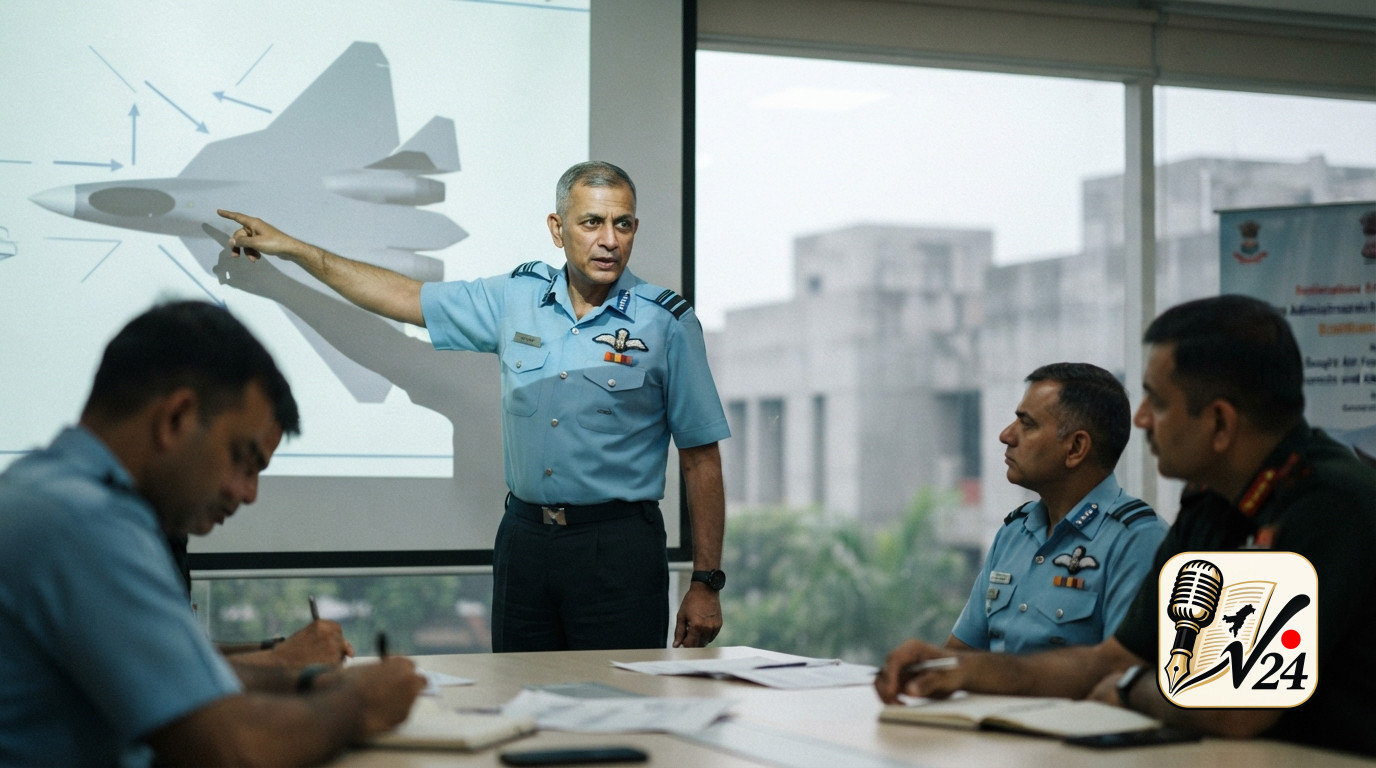
Bengaluru serves as the primary hub for India's aerospace research, development, and defense manufacturing ecosystem, hosting major facilities of Hindustan Aeronautics Limited, the Aeronautical Development Agency (ADA), and specialized defense laboratories. The visit by a senior Indian Air Force officer to review the fifth-generation fighter programme in Bengaluru was focused on evaluating the ongoing technological benchmarks, design progress, and developmental schedules related to advanced stealth platforms. During such high-level assessments, military leadership examines critical components of fifth-generation technologies, including radar-evading airframe designs, advanced avionics, sensor fusion, internal weapons bays, and next-generation engine integrations. The review provides the IAF leadership with first-hand operational visibility into how domestic aerospace institutions are progressing against established milestones, enabling informed planning regarding vector deployments, operational timelines, and potential capability gaps in the coming decades.
What is Russia offering India regarding the Su-57 stealth fighter jet platform?
Russia has presented a renewed and sweetened offer to India concerning its Su-57 fifth-generation fighter aircraft, aimed at addressing the IAF's prospective requirements for heavy stealth combat platforms. Moscow's pitch comes as part of its efforts to secure export partners and re-engage New Delhi in cooperative defense aviation projects. While specific details of the updated commercial and technical terms remain subject to bilateral defense negotiations, Russia's pitch generally emphasizes deep technology transfer, local industrial participation, and opportunities for joint customization to meet specific IAF operational requirements. The Su-57 offer tests India's strategic acquisition choices at a time when the nation is calibrating its multi-layered defense aviation roadmap. Defense analysts note that Russian proposals typically seek to combine off-the-shelf deliveries with localized assembly or manufacturing models, pitching the aircraft as an available option to bridge potential operational timelines while long-term domestic platforms mature.
Why is India evaluating external options like the Su-57 alongside its domestic Advanced Medium Combat Aircraft project?
India's strategic evaluation of external fifth-generation options such as Russia's Su-57 occurs against a backdrop of evolving regional security dynamics, notably marked by the rising presence and deployment of stealth platforms by China along strategic borders. The primary dilemma facing defense planners centers on balancing immediate force-structure requirements against long-term indigenous development timelines. India's current combat fleet relies heavily on existing platforms, including the French-designed Rafale, light combat aircraft such as the indigenous Tejas variants, and modernizing Sukhoi Su-30MKI units. However, as neighboring militaries increasingly field stealthy fifth-generation fighters capable of low-observable operations and advanced sensor networking, the IAF must ensure it retains competitive air defense and strike capabilities. Evaluating foreign platforms allows defense authorities to weigh immediate acquisition choices against the development schedule of the indigenous Advanced Medium Combat Aircraft (AMCA) project, ensuring that temporary capability gaps do not emerge while domestic research and production infrastructure scales up.
How did Defence Secretary RK Singh clarify the status of Hindustan Aeronautics Limited's bid for the stealth jet program?
Speaking at the NDTV Defence Summit, Defence Secretary RK Singh provided explicit clarity regarding news surrounding a failed bid by Hindustan Aeronautics Limited (HAL) in relation to building India's stealth jet. The Defence Secretary explained that HAL's proposal was rejected on fairly routine technical grounds during the standard evaluation phase. Defence Secretary Singh emphasized that such outcomes are part of rigorous, standardized procurement and evaluation processes designed to maintain strict technical compliance, transparency, and operational rigor. By framing the decision around routine technical discrepancies, the defense administration signaled that procedural standards are being strictly enforced across all defense industrial participants, regardless of state ownership, to ensure that chosen execution frameworks meet exact technological specifications required for fifth-generation stealth aircraft.
What role does the Advanced Medium Combat Aircraft project play in India's long-term defense strategy?
The Advanced Medium Combat Aircraft (AMCA) is India's flagship program designed to conceptualize, design, and manufacture a native fifth-generation stealth fighter jet. Led by the Aeronautical Development Agency in collaboration with defense research entities and industrial partners, the AMCA program is central to achieving long-term strategic autonomy and defense self-reliance under national manufacturing initiatives. Developing a fifth-generation fighter domestically requires mastering complex technologies, including radar-absorbent materials, low-radar-cross-section airframe geometry, advanced fly-by-wire controls, integrated sensor suites, and high-thrust engine technologies. While evaluating foreign aircraft options like the Su-57 or expanding existing fleets like Rafale and Tejas offer tactical flexibility, the long-term strategic objective remains establishing a sovereign defense industrial base capable of producing and maintaining stealth platforms independently throughout their operational lifecycle.
How do current operational requirements and regional security concerns influence the IAF's fighter fleet roadmap?
The Indian Air Force's overall fleet architecture is designed around a high-low operational mix, combining light combat aircraft, medium multi-role fighters, and heavy air-superiority platforms. The induction of Tejas variants fulfills local point-defense and light multi-role duties, while the Rafale platform provides advanced 4.5-generation capability equipped with modern avionics and weapons systems. However, regional aerial developments—specifically the deployment of Chinese stealth fighters—have intensified the urgency for fifth-generation capabilities characterized by low observability, supercruise, and advanced network-centric warfare capabilities. As a result, defense planning must carefully orchestrate the timelines for upgrading existing fleets, inducting interim combat solutions if deemed necessary, and ensuring that the indigenous AMCA project transitions smoothly from review stages in aerospace hubs like Bengaluru into full production.
What are the primary technical and procedural hurdles facing domestic defense production for fifth-generation fighters?
Developing and manufacturing fifth-generation combat aircraft involves some of the most complex engineering and administrative challenges in modern industrial manufacturing. On the technical side, domestic defense ecosystems must achieve high precision in composite material manufacturing, stealth coatings maintenance, advanced engine development, and integrated combat systems software. On the procedural side, defense procurement rules mandate strict adherence to technical specifications, cost benchmarks, quality control standards, and project execution timelines. As demonstrated by the routine technical disqualification of HAL's bid during recent procurement assessments, defense authorities are placing a strong premium on exacting procedural compliance. Overcoming these technical and procedural hurdles requires continuous coordination between military evaluators, research organizations, state-owned aerospace entities, and private sector defense partners to build a reliable, high-tech supply chain.
Sources
- The Hindu: Senior IAF officer reviews fifth Gen fighter programme in Bengaluru
- Defence.in: Russia’s Sweetened Su-57 Pitch Tests India’s Rafale, Tejas and AMCA Roadmap Amid Rising Chinese Stealth Threat
- NDTV: HAL Failed Bid To Build India's Stealth Jet On "Routine Technical Grounds": Defence Secretary RK Singh At NDTV Defence Summit
More from National