
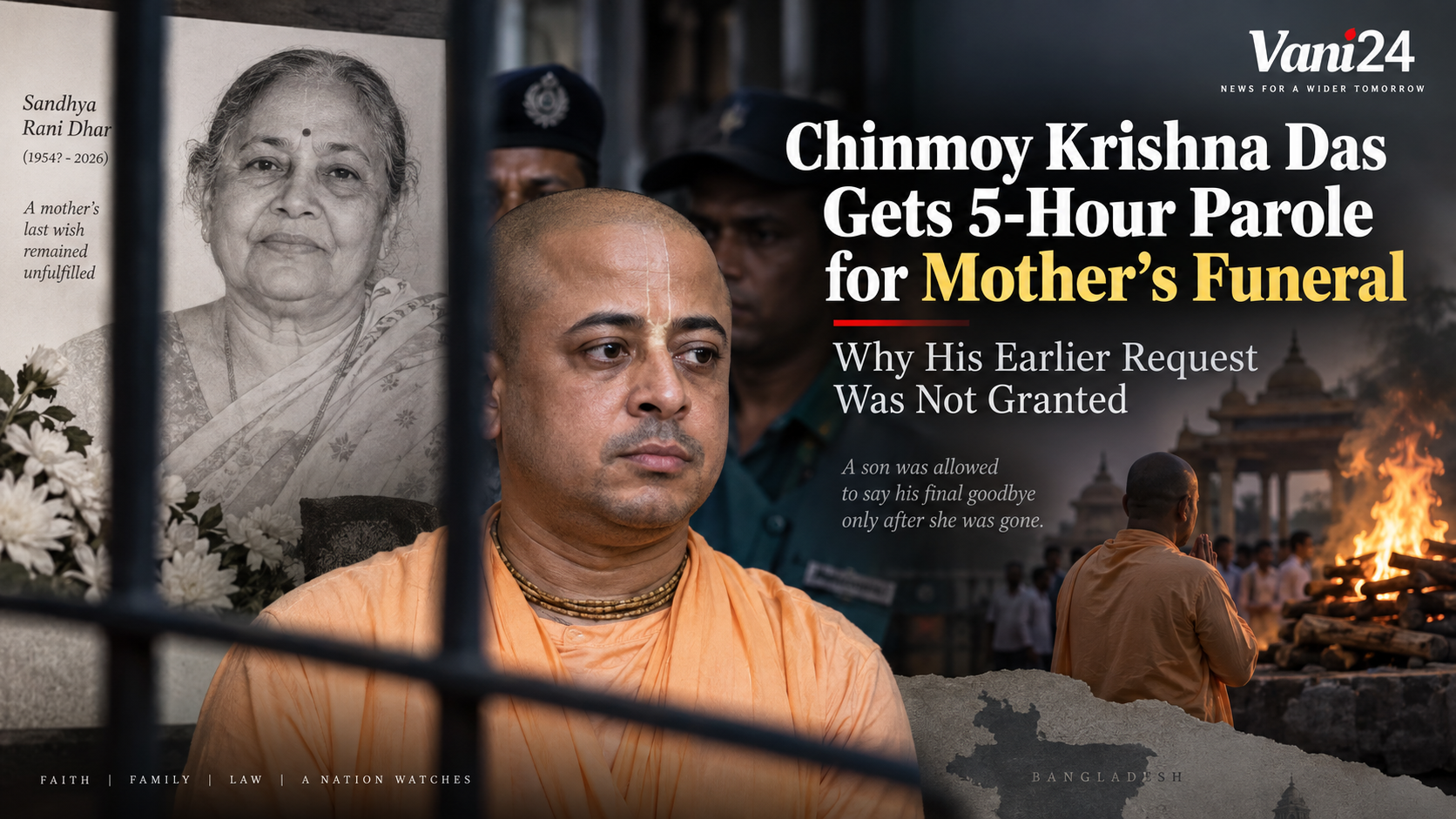
CHITTAGONG, Bangladesh — Former ISKCON leader and Sanatani Jagaran Jote spokesperson Chinmoy Krishna Das Brahmachari was released from Chattogram Central Jail for five hours on September 10 to attend the funeral and cremation of his mother, Sandhya Rani Dhar.
The parole came only hours after his mother died.
What makes the episode significant is the sequence that preceded it. According to Bangladeshi media reports, Chinmoy’s family had approached the authorities the previous day seeking temporary release so that he could see his critically ill mother while she was still alive. The request was not granted. Authorities said there was no legal provision for parole merely to visit an ailing relative, while parole could be considered following the death of a close relative.
The following morning, Sandhya Rani Dhar died.
The family then sought parole again—this time so Chinmoy could attend her final rites. The request was approved, and he was given five hours outside prison under security arrangements.
The sequence has raised questions about the difference between humanitarian circumstances and the legal framework governing temporary release from custody.
What happened first?
Sandhya Rani Dhar had reportedly been undergoing treatment for cancer and other illnesses for nearly two months. Her health had deteriorated to the point that her family wanted her imprisoned son to see her one last time.

According to bdnews24, the family approached the district magistrate on Wednesday, September 9, asking that Chinmoy be released temporarily so he could visit his mother. At that point, however, she was still alive.
Chattogram Additional District Magistrate Syed Mahbubul Haque told bdnews24 that there was no legal provision for granting parole simply so a prisoner could visit an ill relative. He indicated that the situation was different following the death of a relative.
That explanation is central to understanding what happened next.
The family was not initially seeking permission for Chinmoy to attend a funeral. They were seeking an opportunity for a son to see his seriously ill mother before her death.
His mother died the next morning
Sandhya Rani Dhar died at approximately 9:30am on Thursday, September 10, at Pundarik Dham in Hathazari, Chattogram, according to bdnews24.
She had been receiving hospital treatment for nearly two months. Her elder son, Ranjan Dhar, said she had been taken from hospital to Pundarik Dham on Tuesday according to her wishes. Her final rites were also planned there.
Reports differ slightly over her age. The Daily Star reported that she was 70, while Prothom Alo reported 72. What is consistent across the reporting is that she had been seriously ill and had been undergoing treatment before her death.
Following her death, the nature of the request changed.
The family was now asking for Chinmoy to be released temporarily to attend her funeral.
Why was he granted parole after her death?
The Chattogram administration approved the second request.
Chattogram Deputy Commissioner Mohammad Zahidul Islam Mia ordered Chinmoy's release on five-hour parole after receiving an application from his family. The order was issued around 2:30pm, according to The Daily Star.
The administration described the decision as being made in accordance with the law.
This distinction matters.
The authorities did not announce that Chinmoy was being released because his criminal cases had been withdrawn, dismissed or resolved. Nor did the five-hour parole amount to bail or permanent freedom.
It was a temporary release connected specifically to his mother's death and funeral.
What did the five hours mean?
Chinmoy was released from Chattogram Central Jail under arrangements intended to ensure that he could travel to Hathazari, attend the funeral and return to custody.
Additional security measures were reportedly put in place because of the sensitivity surrounding his case and his public profile.
The parole therefore had a very narrow purpose.
He was not being released to resume normal activities. He was being permitted to perform the religious and family obligations associated with his mother's death before returning to prison.
The five-hour period is particularly significant because it illustrates the limited nature of the permission: the administration allowed temporary physical presence at the funeral without changing his underlying custodial status.
Why was the earlier request different?
This is the most important factual question.
The two requests involved two different circumstances.
First request: Chinmoy's mother was alive but critically ill. His family wanted him released temporarily so that he could see her.
Second request: His mother had died. His family wanted him released temporarily to attend her funeral.
According to the Chattogram administration's explanation reported by bdnews24, the applicable arrangement did not provide parole simply for visiting an ill relative, while release could be considered after the death of a relative.
That explains why the second request was approved when the first was not.
It does not, however, establish that officials had unlimited discretion to release him earlier and deliberately chose not to do so.
That distinction is important in a factual news report.
Was Chinmoy's detention related only to the sedition case?
No.
This is another point that requires clarification because Chinmoy's detention has developed through several criminal proceedings.
Chinmoy was arrested in Dhaka on November 25, 2024, in connection with a sedition case filed over allegations that he and others disrespected Bangladesh's national flag during a Hindu community rally in Chattogram.
The case was filed on October 31, 2024, by Firoz Khan, then a BNP ward-level leader. Prothom Alo reported that the complaint named Chinmoy and 18 others.
His arrest was followed by a major confrontation outside the Chattogram court on November 26, 2024.
After a court rejected his bail, supporters reportedly blocked the prison van carrying him. Clashes subsequently broke out involving Chinmoy's supporters, police and lawyers.
Lawyer Saiful Islam Alif was killed during the violence outside the court premises.
Chinmoy was subsequently shown arrested in the murder case involving Alif. A Chattogram court later accepted a police charge sheet against 39 accused in that case, with Chinmoy among those accused.
These are allegations and ongoing judicial proceedings, not findings that Chinmoy has been convicted of the offences.
Why has he remained in custody despite receiving bail in some cases?
Because bail in one case does not necessarily result in immediate release when other criminal cases remain pending.
That distinction became particularly relevant in Chinmoy's case.
In April 2026, a Chattogram court granted him bail in one case, but The Daily Star reported that he remained in jail because six other cases were still pending, including the case concerning lawyer Saiful Islam Alif's death.
Earlier, in April 2025, the High Court had granted Chinmoy bail in the sedition case after 156 days in jail. The state subsequently challenged the decision, creating further legal proceedings around his release.
Therefore, describing Chinmoy simply as someone who is "in jail for sedition" does not fully explain his current legal position.
His continued detention has been connected to multiple proceedings.
Why does the parole decision matter?
The controversy is not simply about five hours.
It is about timing.
The family sought temporary access to Chinmoy while his mother was alive and seriously ill. The authorities' stated position was that the relevant parole arrangement did not provide for release merely to visit an ill relative.
Once she died, the legal circumstances changed and a five-hour parole was approved for her funeral.
That creates an obvious humanitarian question:
Should the legal system have a mechanism allowing a prisoner to temporarily meet a critically ill parent or close family member before death?
That is a legitimate policy question.
But it should not be confused with an established finding that authorities unlawfully denied Chinmoy access to his mother.
The reporting currently establishes what the administration said about the legal provision. It does not, by itself, establish that the authorities had a lawful alternative available and intentionally refused it.
What can be established as fact?
The chronology is relatively straightforward.
- Sandhya Rani Dhar had been seriously ill and undergoing treatment.
- Her family sought parole for Chinmoy while she was still alive.
- The Chattogram administration said there was no provision for parole merely to visit an ill relative.
- Sandhya Rani Dhar died on September 10 at approximately 9:30am.
- Her family then sought parole so Chinmoy could attend her funeral.
- The request was approved.
- The Chattogram administration ordered five-hour parole.
- Additional security arrangements were made for his movement.
- Chinmoy attended his mother's final rites and was required to return to custody.
Those facts tell the story without requiring speculation about motives.
What remains unanswered?
The most difficult question is not necessarily a criminal-law question.
It is a question of humanitarian policy.
Should prisoners facing serious criminal allegations have a defined mechanism for temporary access to critically ill parents?
If such discretion exists, what conditions should apply?
Would security concerns prevent such a release in a politically sensitive case?
And if a prisoner is considered too sensitive to release while a relative is alive, should there be another mechanism—such as a secure hospital or prison visit—to allow a final meeting?
The present reporting does not provide definitive answers to those broader questions.
What it does show is a gap between the family's request and the legal mechanism the authorities said was available.
Five hours, after the final goodbye was no longer possible
Chinmoy Krishna Das's five-hour parole was therefore not a release from his legal troubles.
It was a narrowly defined temporary permission granted after his mother's death.
The significance of the episode lies in the sequence: the family sought an opportunity for Chinmoy to see his critically ill mother; that request was not granted under the authorities' stated interpretation of the applicable parole rules; she died the following morning; and a subsequent request to attend her funeral was approved.
There is no evidence from the reporting that the authorities caused or contributed to Sandhya Rani Dhar's death. There is also no established basis for saying that Chinmoy's earlier release would certainly have changed the outcome.
But there is one fact that explains why the incident has generated such strong reaction.
The permission to leave prison came after the person Chinmoy wanted to see was no longer alive.
For five hours, he was allowed to leave custody, travel to his mother's final rites and perform his duties as a son.
Then he returned to prison.
The legal cases continued.
The political controversy continued.
But the opportunity for a final meeting with his mother had already passed.
More from National